
The Violence of Welcome
Grey BeesIn Crimea and on the road, ordinary hospitality coexists with coercive policing, propaganda, and suspicion of people marked as outsiders.
increasing Bearing strength in each event
 decreasing
Bearing strength in each eventdecreasingA Stranger at the Border

A Stranger at the Border
Sympathy as a narrative frame
Officials describe Sergeyich as a victim from Donbas and invite him to speak to journalists. When he mentions Russian forces, the interview is redirected toward a safer account.
A story edited for use
The cameras record the damaged car and hive while avoiding the details that complicate the preferred narrative. Sergeyich receives repair money, but understands that his experience is being shaped by others.
A Visit to the Security Service

A Visit to the Security Service
Questions turn toward the visitor
At the Federal Security Service, Ivan Fyodorovich asks about Sergeyich’s Ukrainian soldier friend and warns him to remember that he is a foreigner. The inquiry about Akhtem becomes an interrogation about Sergeyich himself.
A narrow answer
The official directs Aisylu to police and mentions missing-person cases but offers no practical help. His slip calling her a widow deepens Sergeyich’s fear that Akhtem is dead.
The Bees Become Suspect
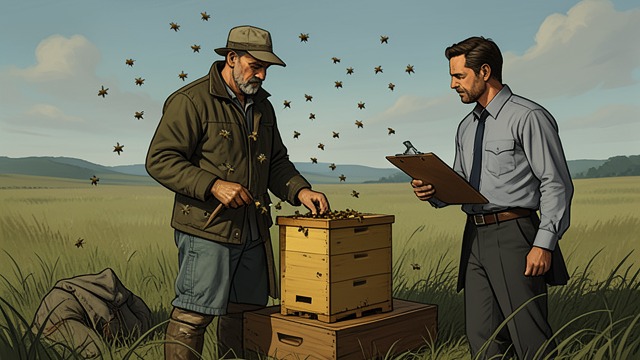
The Bees Become Suspect
Sanitation as leverage
Ivan Fyodorovich returns with a supposed specialist and removes one hive, claiming the bees may carry disease. The official rationale transforms Sergeyich’s livelihood into an object of state control.
Fear follows the inspection
Sergeyich suspects retaliation for his questions about Akhtem and Bekir. When the returned bees behave strangely, the beekeeper cannot separate real risk from the atmosphere of intimidation.
Sergeyich’s entry into Crimea
mid-summer, during Sergeyich’s stay in Crimea
late summer, before Sergeyich leaves Crimea
